


News Blog
Latest news on Spanish companies and economy

Confebask, CEV, AFM, Asle and Elkargi join forces to demand a national pact for transformation and Basque well-being.
Five business and financial organizations from the Basque Country—Confebask, the Circle of Basque Entrepreneurs (CEV), AFM, ASLE, and Elkargi—have presented a joint statement titled “Euskadi in a New Era: A Country Pact for Competitive Transformation and the Future Well-being of Euskadi.” They call for a stable, long-term commitment involving institutions, political parties, unions, universities, and civil society to tackle challenges such as the loss of relative weight against global powers, the energy transition, the rise of artificial intelligence, demographic aging, and access to housing. The aim is to align efforts to boost innovation, create quality jobs, and sustain excellent public services, seeking a shared vision that transcends electoral cycles and guarantees the territory’s future well-being.
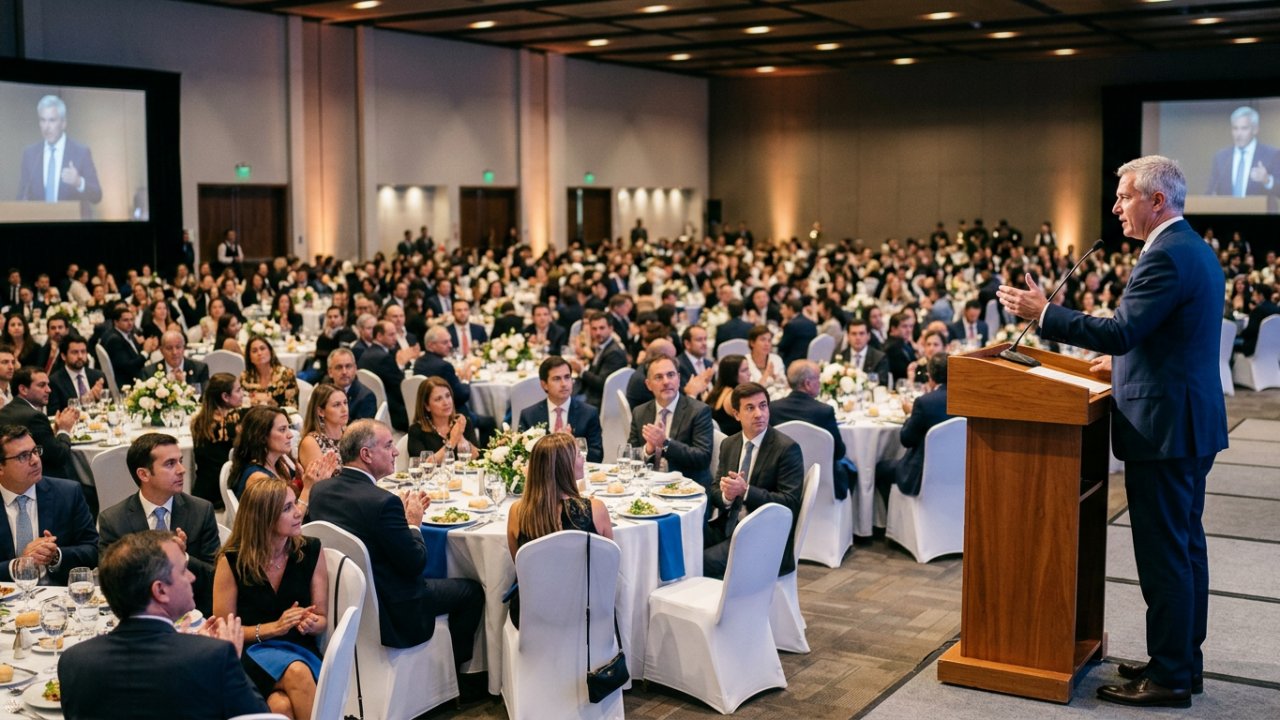
More than 650 guests gathered at the 2026 Annual Dinner of the Spanish Chamber of Commerce in Chile.
The Spanish Official Chamber of Commerce in Chile (CAMACOES) held its traditional Annual Dinner 2026, an event that brought together more than 650 guests at CentroParque in Santiago to commemorate the institution's 107 years of history. Senior government authorities, members of the diplomatic corps, parliamentarians, industry leaders, and prominent executives from the private sector attended, gathered to reinforce the strategic ties between Spain and Chile. The President of the Chamber, Miguel A. García Moreno, opened the ceremony with a speech in which he highlighted the organization's role as a driver of collaboration, investment, and bilateral dialogue, and he observed a minute of silence for the victims of a railway accident in Toledo, Spain. The impact of Spanish investment in key sectors for Chile—infrastructure, energy, innovation, and financial services—was underscored, as well as the support of companies such as Acciona and Sacyr. The dinner also served as a high-level networking platform and a chance to reflect on recent milestones such as ChileDay 2026 in Madrid, reaffirming the Chamber's commitment to strengthening commercial and cultural relations between the two countries.

Madrid and Catalonia account for 62% of the value of public procurement awarded in the third quarter.
Public procurement in Spain reached significant figures during the third quarter of 2026, with a total of 30,844 awards amounting to a global value of 10,140 million euros. According to the study conducted by Informa D&B through its Avaldata product, contract activity between the months of July and September shows a marked geographic and sectoral concentration, as well as a clear dominance of large companies in terms of economic volume. In territorial analysis, the Community of Madrid and Catalonia consolidate as the main centers of public investment, jointly accounting for 62% of the total awarded amount in the country. Madrid leads the ranking with 4,149 million euros, representing 41% of the national total, distributed across 8,404 contracts with an average of 493,700 euros per award. Catalonia occupies the second position with 2,154.5 million euros (21% of the total) and 4,977 awards, with an average of 432,900 euros per contract. Although these two regions concentrate most of the capital, they only represent 43% of the total number of contracts, indicating that awards in these areas tend to be of higher magnitude. Andalusia ranks third with 1,063.5 million euros (10.5%), followed by Galicia with 640 million (6%) and the Valencian Community with 503 million (5%). Together, Madrid, Catalonia and Andalusia concentrate almost three-quarters of the capital allocated in this period, evidencing the centralization of economic activity in these territories. From a sectoral perspective, Construction remains the main engine of public procurement, with 3,300 million euros awarded, representing 32.5% of the national amount. This sector leads in 16 of the 19 Spanish autonomous communities. Other relevant sectors include Trade and distribution (1,317 million), Healthcare and social services (849 million), Media, telecommunications and technology (821 million), and Business and auxiliary services (809 million). Regarding the profile of the awarded companies, the report highlights a considerable gap according to company size. Large companies, those with turnover above 500 million euros, captured 68% of the total amount (6,895 million euros) despite obtaining only 1,608 awards. In contrast, small and medium-sized enterprises (SMEs) received 31.5% of the capital (3,194 million), although they protagonized the vast majority of contracts, with 21,444 awards (69.5% of the total numeric). Finally, the study identifies the firms with the highest individual award volume. Atende Integrated Services leads the list with 239.6 million euros (2.36% of the national total), followed by Serveo Social with 184.5 million (1.82%). In daily terms, public procurement in Spain averaged 335 awards and 110.2 million euros during this third quarter, involving a total of 11,909 distinct companies. The average amount per award stood at 328,800 euros, though this value fluctuates significantly depending on the region and the sector analyzed. This landscape reflects Spain’s economic structure, where large decision-making centers act as magnets for state and regional investment, posing challenges for territorial diversification and SMEs’ access to large-scale contracts.

When the entrepreneur becomes the biggest obstacle to his own business
The article delves into the vision and work of Miquel Pino, a renowned economist and mentor to entrepreneurs with more than 30 years in the sector. Throughout his career, Pino has worked closely with more than 1,300 owners of small and medium-sized enterprises, self-employed professionals, and managers of family businesses, helping them navigate the complex challenges of business management. Pino strongly argues that being happy should be considered a business objective as valid as profitability or growth. He notes a dangerous tendency to equate overworking with effective leadership. However, his experience has taught him that putting in long hours does not guarantee successful management; on the contrary, it can lead to burnout and poor decision-making. This mindset of extreme sacrifice often leads to what he calls the entrepreneur's solitude, a state in which the leader feels isolated and overwhelmed by responsibilities, ultimately affecting both personal life and business performance. In his works, such as Lidera, gana y sé feliz and La mente del nuevo empresario, Pino explores these dynamics and offers tools to transform the leader's mindset. His most recent book, Nunca digas A mí no me va a pasar, stems from a pivotal personal experience: an accident that temporarily forced him to use a wheelchair. This experience served to illustrate that the unpredictable is a constant in life and in business. He warns that success can foster dangerous complacency, causing entrepreneurs to ignore risks until it is too late. Therefore, he advocates proactive preparation, strengthening the business and the leader themselves during good times so as to face any future eventuality. The mentor emphasizes that team management and the ability to delegate are essential for the entrepreneur to regain freedom and well-being. By ceasing to be the center of all tactical operations, the leader can focus on strategy and on their own personal growth. Pino emphasizes that asking for help is not a sign of weakness, but of business intelligence. His holistic approach seeks that businesses not only survive but prosper in a way that allows their owners to enjoy a full quality of life, integrating professional success with personal fulfillment and happiness. Ultimately, it is about making the company a vehicle for the individual's realization and not a burden that consumes their existence.

Businesspeople and academics defend responsible artificial intelligence that serves people.
The First Emilio Tortosa Conference, held last October 28 at CaixaBank’s headquarters in Valencia, established itself as a fundamental space for analyzing the ethical and human challenges posed by artificial intelligence (AI) today. Organized by the Valencian Association of Entrepreneurs (AVE) and the Étnor Foundation, the meeting under the title “Challenges and Commitments in the Face of AI: the Role of Entrepreneurs” brought together a broad representation of the business, academic, and technological worlds with the aim of promoting a technological adoption that prioritizes the well-being of society. During the event, an exhaustive conclusions report derived from the #TallerAVEtnor on AI was presented, a project developed throughout 2026 in collaboration with Deloitte and the LAB Mediterráneo Foundation. This document stands out for including a decalog of commitments designed to guide organizations in the implementation of responsible AI. The principles contained in this decalog are grounded in European values, with particular emphasis on transparency, security, privacy protection, and the need to always maintain human oversight over automated processes. Agnès Noguera, vice president of AVE and member of the Executive Committee of the Étnor Foundation, was in charge of opening the conference, highlighting the importance of the business sector actively engaging in the debates that define the collective future. Noguera recalled that this initiative follows in the wake of other prior collaborations on sustainability and education, now placing AI at the center of the strategy to improve competitiveness without losing sight of ethics. For her part, Adela Cortina, academic director of the Étnor Foundation and professor at the Universitat de València, stressed that ethical companies are essential for strengthening democracy and social benefit, urging leaders to see technology as a tool for human flourishing. The conference featured experts such as Santiago Vallejo, president of Isaval Global, and Jesús Conill, professor of Moral and Political Philosophy, who, along with technical professionals such as Sergio Velasco (Exponentia), Miguel Juan (S2 Grupo), and María Pocovi (Clearspeed), debated the practical application of AI. They discussed how to move from technical experimentation to strategic adoption that mitigates risks such as algorithmic biases and the dehumanization of work. The closing of the event reaffirmed the commitment of Valencian entrepreneurs to lead a digital transformation with values, honoring the memory of Emilio Tortosa and his legacy in promoting ethics in business.

Ronaldo Nazário returns to the controversy over an image created with AI: The business empire that 'The Phenomenon' is building.
The legendary Brazilian footballer Ronaldo Nazário, universally hailed as 'The Phenomenon,' has once again found himself at the center of controversy in his homeland. The cause of this new uproar is the widespread circulation of an image and a video generated by artificial intelligence that show the former Real Madrid and FC Barcelona striker expressing alleged political support for Brazil’s current president, Luiz Inácio Lula da Silva, and the minister of the Supreme Federal Court, Alexandre de Moraes. This content, designed to influence the political climate ahead of the 2026 elections, has been categorically denied, reminding that Ronaldo has opted for a neutral stance after the polarized experiences of previous years. This phenomenon of misinformation is not new for the Brazilian star. Recently, his image and voice were digitally cloned for an advertising scam promoting the online game Plinco. In that video, a synthetic version of Ronaldo urged users to download the app promising easy profits, a case of deepfake so sophisticated that it was analyzed by Meta’s Oversight Board. These attacks underscore the vulnerability of celebrities to the malicious use of AI, which seeks to capitalize on the public’s trust in iconic figures for political or fraudulent purposes. However, the article not only centers on the challenges of the digital era, but also offers a detailed look at the robust business empire Ronaldo has built with the same precision with which he defined in front of the goal. After his retirement, which he himself emotionally described as his "first death," Ronaldo reinvented himself as an elite manager. His trajectory as owner of Real Valladolid in Spain and Cruzeiro in Brazil marked a milestone, proving that his knowledge of football could translate into administrative and financial success. The sale of his shares in these clubs in 2024 and 2025 closed a cycle of restructuring and institutional growth under his leadership. The Phenomenon’s empire diversifies through holdings such as Tara Sports and renowned agencies like Octagon Brazil, which manages the image of major athletes and global brands. Additionally, his foray into ultra-luxury real estate is evident with the acquisition of an exclusive $7.8 million penthouse in Miami, consolidating his presence in a city that has become the new capital of football in the United States. Through R9 Gestão and Oddz Network, Ronaldo oversees a network that ranges from international football schools to content producers like Beyond Films. At 50, Ronaldo Nazário demonstrates that his business vision is as sharp as his goalscoring instinct, remaining a central figure in the global sports and entertainment industry, despite attempts to tarnish his image with emerging technologies.

Public subsidies in Spain: how to turn business projects into engines of change
Public subsidies in the Spanish territory have consolidated in recent years as a fundamental and strategic avenue for small and medium-sized enterprises (SMEs) and autonomous workers to drive growth, improve competitiveness, and secure long-term viability. This financial support, which comes from a combination of state, regional, and European Union funds, acts as a powerful catalyst to accelerate the transformation necessary for the Spanish business fabric. The main objective is to enable businesses, regardless of size, to digitalize their internal processes, innovate in the creation of new products or services, and decisively advance toward business models based on sustainability, energy efficiency, and internationalization. Access to these public funds, however, is not a simple process and requires extremely rigorous strategic and operational planning. Companies and entrepreneurs must undertake an introspective exercise to translate their real business needs into technical projects that precisely align with the objectives and specific requirements of each public call. This alignment is absolutely crucial, as it ensures compliance with the strict eligibility criteria and facilitates precise documentation management, which significantly maximizes the chances of success in obtaining the aid. In this regard, subject-matter experts, such as Marta Grañó, professor of Leadership and Innovation at OBS Business School, emphasize that good foresight and proper advice are essential to avoid unnecessary treasury tensions and to navigate possible legal incompatibilities between different subsidy lines. Public aid for companies in Spain is mainly structured around four large strategic axes: digitalization, innovation, internationalization, and energy transition. In the digitalization field, initiatives such as the 2021-2025 SME Digitalization Plan, backed by the Next Generation EU European funds, are vital to reduce the technological gap between large corporations and small businesses. Regarding innovation, the goal is to foster not only pure research but also the practical application of new technologies in production processes. Internationalization aims for Spanish companies to gain presence in foreign markets, diversifying their sources of income. Finally, the energy transition supports projects that promote decarbonization and the use of renewable energies, aligning companies with global climate objectives. To channel these resources, there are several reference bodies and institutions. At the national level, the National Innovation Company (Enisa) stands out for its financing lines for young entrepreneurs and technology-based companies. Likewise, the Chamber of Commerce and the Official Credit Institute (ICO) play a fundamental role in resource distribution and financial counseling. At the European level, the European Commission periodically launches calls that facilitate access to capital at all stages of the business life cycle. In short, public subsidies are not just an injection of capital, but a transformation instrument that, well managed, allows turning business projects into true engines of change for the Spanish economy.

José Elías, billionaire entrepreneur: "I often see very good founders building things that they then don't know how to sustain. They fail because they don't know how to step aside."
José Elías, one of the most influential and well-known businessmen in Spain, has recently shared a deep reflection on success and failure in the business world through his profile on the social network X (formerly Twitter). Elías, whose career is marked by the creation of a vast empire spanning sectors as diverse as renewable energies, telecommunications, and food—being owner of companies such as Audax Renovables or the frozen food chain La Sirena—has surprised his community by openly admitting his own limitations as a manager. In his message, the billionaire states with brutal honesty: "I’m not cut out to manage companies. And realizing that was one of the best things that has happened to me." This confession highlights one of the most valuable lessons he has learned over his long career: the critical importance of knowing oneself and having the humility to recognize in which areas one excels and in which one falters. Elías explains that he possesses an innate and highly developed ability to detect latent market needs and to build business structures from scratch to meet them. However, he frankly acknowledges that his enthusiasm, patience, and operational efficiency drop dramatically once the project is underway and requires daily, meticulous, long-term management. The entrepreneur details that, had he relied exclusively on his own capacity for management, he would have found himself trapped in an exhausting and unproductive cycle of creating and then dismantling companies. To avoid this fate, he chose a solution that he himself calls "much smarter" than trying to change his own nature: surround himself with a team of trusted professionals who excel precisely in the administrative and operational tasks that he struggles with. In his reflection, he mentions with gratitude key collaborators on his team, such as Anabel, Rosa, Xavi, and Óscar, whom he attributes the real credit for turning his visions and initial ideas into solid, profitable, and enduring companies that continue to operate successfully many years after their founding. Elías's reflection transcends the personal to become a warning for a new generation of entrepreneurs. According to his direct observation of the business ecosystem, many founders with exceptional talent for innovation and launching ventures end up failing spectacularly because they cannot "take a step aside" at the right moment. This inability to delegate or to understand that the psychological and professional profile required to found a company is not at all the same as what is needed to lead it in its mature and consolidated phase is, in his view, one of the most recurring causes of the disappearance of projects that were born with brilliant ideas. With this publication, José Elías seeks to demystify the romantic image of the "one-man band" entrepreneur and emphasizes that true sustainable success lies in forming complementary teams where specializations are respected. His personal story, characterized by building nearly 200 companies and weathering two bankruptcies in the past with resilience, serves as a powerful testament that self-criticism and strategic delegation are as fundamental to business survival as commercial vision or financial capital. In an environment where the founder’s ego is often rewarded, Elías advocates for emotional intelligence and the courage to cede operational control to ensure that the legacy and structure of projects endure over time.

Institutional trip to Chile, Argentina and Uruguay tightens ties over the Spanish language and explores business opportunities.
The Government delegation of La Rioja, led by its president Gonzalo Capellán, has concluded its institutional trip to the Southern Cone with a remarkably positive balance. The trip included strategic stops in Santiago de Chile, Buenos Aires, and Montevideo from October 25 to 31, 2026. The mission’s primary objectives were to strengthen cultural and institutional ties through the Spanish language, open new markets for La Rioja’s companies, and tighten ties with emigrant communities and their descendants in these three South American countries. In the realm of culture and language, the delegation reaffirmed the fundamental role of La Rioja as the cradle of Spanish, highlighting the legacy of the San Millán de la Cogolla monasteries. During the journey, high-level meetings were held with the Chilean Academy of Language and the Argentine Academy of Letters, in addition to delivering lectures at prestigious academic institutions such as the Pontifical Catholic University of Chile, the University of Buenos Aires (UBA), and the University of the Republic in Uruguay. These activities allowed the projection of the value of Spanish, a heritage shared by more than 630 million people, and the promotion of the exhibition 'AutorIA. La Rioja, land of Spanish,' which analyzes the impact of artificial intelligence on the future of our common language. From an economic and business perspective, the trip sought to diversify the destinations of La Rioja’s exports, which currently depend 80% on the European market. Accompanied by the Director General of Business, Amadeo Lázaro, and the Director of Development of La Rioja Investments, Víctor de Pablo, President Capellán presented the region’s strengths in key sectors such as agri-food, footwear, and technology. In Chile, meetings were held with the Sociedad de Fomento Fabril (SOFOFA) and the Chamber of Commerce of Spain, while in Argentina and Uruguay opportunities in innovation and wine production were explored, highlighting the visit to the Uruguayan National Institute of Viticulture (INAVI) to exchange knowledge on regulation and promotion of the sector. Innovation was another central pillar of the agenda, with visits to the Innovation Center of the Pontifical Catholic University of Chile and the 'startuplab' hub, as well as the Buenos Aires Innovation Park. These encounters facilitated contact with researchers and deep-tech entrepreneurs, laying the groundwork for future collaborations within the framework of the TECHRIOJA project. Finally, the mission had a very emotionally human component as it visited La Rioja centers abroad. The president participated in the San Mateo celebration in Santiago de Chile and met with the community in Buenos Aires. However, the trip was marked by national mourning following the Urda railway tragedy, with the delegation paying tribute to the victims, including a La Rioja citizen who died, through a minute of silence at the Embassy of Spain in Buenos Aires. In short, the mission has succeeded in strengthening La Rioja’s international presence, opening doors to future investments and consolidating its cultural identity in Ibero-America.